For owners and leadership teams
Cyber risk assessment and advisory services for small and mid-sized companies.
The assessment estimates what cyber risk costs your company in an average year and in a bad year, stated in dollars. Recommended fixes are ranked by estimated risk reduction relative to cost.
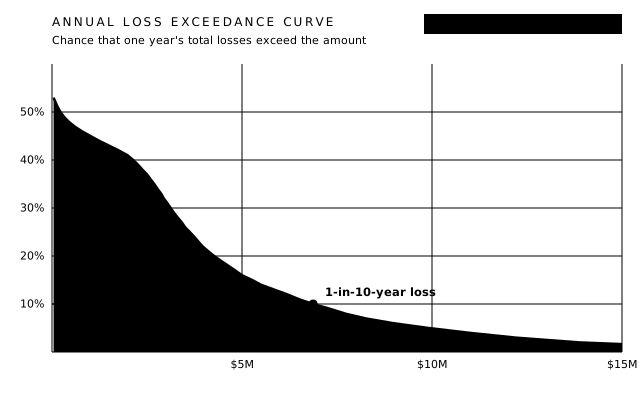
Figures are illustrative output from a sample engagement. All risk figures are modeling estimates based on stated assumptions and published industry loss data: planning inputs, not predictions or guarantees.
The executive problem
Security advice rarely arrives in a form leadership can budget against.
Fragmented advice
Your IT provider, insurer, auditors, and vendors each see part of the risk picture. No single party is responsible for the whole of it.
Scores, not dollars
Recommendations usually arrive as ratings: red, yellow, green. A rating does not state what a risk costs in dollars or which fix is worth funding first.
Proof pressure
Boards, clients, insurers, and partners increasingly ask for evidence of a working security program, not assurances.
First engagement
The Cyber Risk Assessment
A 2-3 week, fixed-fee assessment that estimates how much cyber risk your company is carrying, in dollars, and which fixes warrant funding first.
Interviews with 3 to 5 members of your leadership team, review of the policies and vendor documents you already have, and an external scan of your internet-facing footprint, performed under written authorization. A few hours of your time in total.
Each identified risk scenario is assigned an annual likelihood and a financial impact range, scaled to revenue and downtime cost figures you provide. A simulation model produces an estimated annual loss figure, loss percentiles, and a ranking of proposed controls by estimated risk reduction relative to cost.
We prepare the deliverables below and present the results to your leadership team in a readout meeting.
What leadership receives
A board-ready cyber risk decision package.
Executive risk report
Findings, your estimated annual loss, recommended controls ranked by estimated risk reduction relative to cost, and a methodology and assumptions appendix.
Board briefing
A summary of the exposure in dollars and the specific decisions requiring management action.
30/60/90-day roadmap
Recommended actions over 30, 60, and 90 days, each with a proposed owner and completion criterion.
Deliverables are produced by a documented, repeatable model; figures are consistent across all documents.
Why XLerate Cyber
How the work is done.
Risk stated in dollars
Most security reviews produce a maturity score and a heat map. This assessment assigns each risk an annual likelihood and a financial impact range and states the result in dollars, with recommendations ranked by estimated risk reduction relative to cost.
Led by operators
The work is led by people who have run IT and security inside small and mid-sized companies for more than 20 years. XLerate Cyber is a practice of XL.net, an established managed IT firm.
Measurement before alignment
The risk is measured before any framework alignment work begins. Remediation is sequenced by the control ranking, so the fixes with the largest estimated risk reduction relative to cost come first. Framework alignment follows under the Security Advisory Program.
You will get the most from this if
- Your leadership answers to a board, an insurer, clients, or investors.
- Your company is roughly 10 to 250 people.
- A renewal, a diligence request, a budget decision, or a recent scare is on the table.
Regulated and professional-services firms are the most common fit, because they already face questionnaire, audit, and insurance requirements. If your situation differs, the fit call is the quickest way to find out whether the assessment applies.
After the assessment
The Security Advisory Program
The assessment may be purchased alone, and most clients decide about ongoing work after the readout. For those who continue, XLerate Cyber provides the Security Advisory Program: recurring governance, documentation, and reporting, with work prioritized by the assessment's control ranking. The program includes:
- Governance meetings. Facilitation of recurring security governance meetings, including agenda preparation and recorded minutes.
- Framework tracking. Maintenance of your control framework status (for example, the CIS Controls), evidence records, and compliance reporting on request.
- Policy documentation. Revision and preparation of security policy documents to reflect your actual environment.
- Questionnaire assistance. Assistance preparing accurate responses to client security questionnaires and IT assessments.
- Annual reassessment. An annual update of the risk assessment, included in the program.
- Awareness training. Definition and tracking of a security awareness training and phishing simulation program.
- Incident response planning. Maintenance of the incident response plan and facilitation of an annual tabletop exercise. Incident response execution is excluded.
- Vendor risk process. Definition and maintenance of a third-party risk review process scaled to your staffing.
- Insurance applications. Review of cyber insurance application responses against documented controls prior to submission.
Common questions
Questions that come up on most fit calls.
We already have an MSP or IT provider.
The assessment does not replace your IT provider, and their work is used as an input. An IT provider reports what is technically wrong. This engagement estimates what those findings cost in dollars and which fixes warrant funding first. The two roles are complementary.
We already have cyber insurance.
Insurance transfers part of the risk. It does not reduce the underlying exposure, and it does not identify which fixes are worth funding. The assessment produces the loss estimates that policy limits and reserves can be checked against, and the documented controls can support insurance application responses.
How is this different from a pen test or an audit?
A penetration test identifies technical vulnerabilities. An audit verifies conformance with a standard. Both produce findings without financial context. This assessment estimates, in dollars, what each major risk costs and ranks fixes by estimated risk reduction relative to cost. Penetration test and audit findings are used as inputs where they exist.
How did you arrive at the numbers?
Estimates start from published industry loss studies, are adjusted through interviews and a review of your controls, and are scaled to revenue and downtime cost figures you provide. Every estimate is a range, and every likelihood, impact range, and control assumption is listed in the report. Any input you dispute can be revised and the analysis rerun; revised inputs and results are documented alongside the originals. These are modeling estimates based on stated assumptions, not predictions or guarantees.
What do you need from us, and how much of our time?
Interview availability for 3 to 5 leadership participants, about one hour each; revenue and downtime cost figures, provided as ranges; the policies and vendor documents you already have; and a discussion of how much risk your management is prepared to accept. We handle most of the evidence collection.
Do you act as our CISO?
No. XLerate Cyber serves in an advisory capacity only: we assess, recommend, document, facilitate, and report. We do not hold the CISO role or any officer, management, or staffing position, and decision authority and risk acceptance remain with your management. The accurate characterization of the engagement, including on client questionnaires, is that your company retains an external security advisory firm.
Do you handle security incidents?
No. The engagement does not include incident response, digital forensics, breach containment or remediation, ransom negotiation, continuous monitoring, a security operations center, or managed detection and response. Incident response planning and an annual tabletop exercise are available under the Security Advisory Program; response work itself would be arranged separately.
Who is behind this
Built from practical operating experience.
Founder Noel Catrambone brings 20+ years of IT and cybersecurity leadership across financial services, private equity, asset management, fintech, and regulated public-company environments. He has advised executive teams across 200+ client relationships. XLerate Cyber is a practice of XL.net, an established managed IT firm.
Role and boundaries: XLerate Cyber serves in an advisory capacity only: we assess, recommend, document, facilitate, and report. We do not act as your CISO or hold any officer or management position, and decision authority and risk acceptance remain with your management. The engagement does not include incident response or security operations. Noel has led recovery efforts for major ransomware events; that experience informs the advice, and response work itself is arranged separately. The engagement is also distinct from any managed IT relationship with XL.net.
Next step
Start with a 30-minute fit call.
We confirm your pressure points, scope, timing, and the exact fee, and whether the 2-3 week assessment is the right first move. If it is not, we will say so on the call.